


Difference Between Emergency First Aid at Work and First Aid at Work
When a colleague collapses, a visitor suffers a severe bleed or a child has a serious allergic reaction, the person responding does not have time to look up a policy. They need the confidence to act. Understanding the difference between emergency first aid at work and first aid at work helps you choose training that fits the real risks in your organisation, protects your people and supports your legal responsibilities.
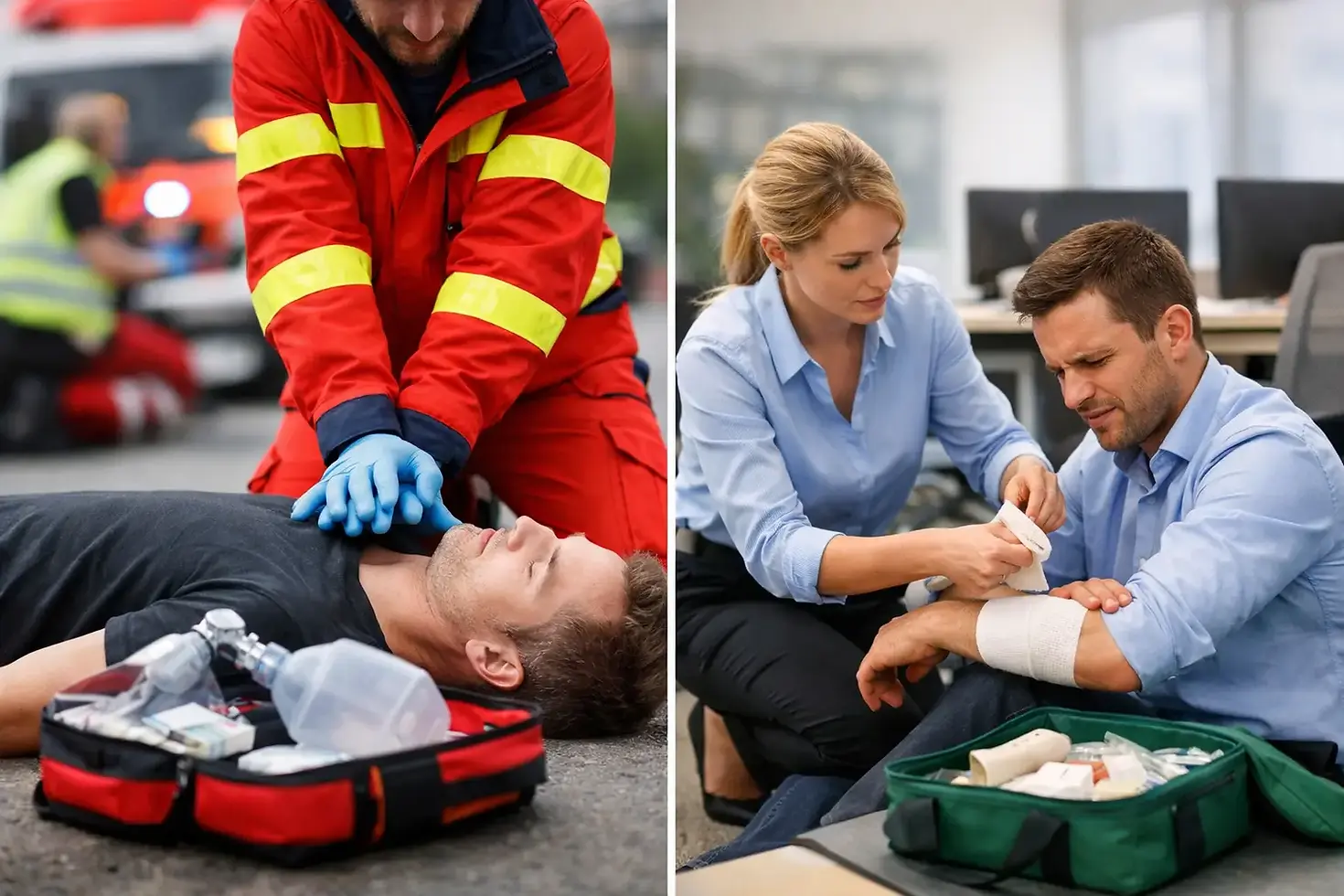
Both qualifications teach lifesaving first aid skills. The key difference is the depth, breadth and likely suitability for your workplace. Emergency First Aid at Work is designed for lower-risk environments and immediate incidents. First Aid at Work is a more comprehensive qualification for workplaces where the risk assessment identifies a greater need for first aid provision.
Emergency First Aid at Work: focused skills for immediate action
Emergency First Aid at Work, often called EFAW, is normally a one-day course. It gives staff the practical knowledge to assess an incident, protect themselves and others, and provide urgent help until the emergency services arrive or the casualty can receive further care.
It typically covers the most critical workplace emergencies. Learners practise assessing an incident, managing an unresponsive casualty, placing somebody in the recovery position, delivering CPR, using an automated external defibrillator where available, responding to choking, treating seizures and controlling bleeding. They also learn how to record incidents and understand the role of a first aider in the workplace.
For many lower-risk offices, small shops, community venues and similar settings, this may be the right level of provision. It can give nominated staff the skills to respond decisively to the emergencies most likely to demand immediate intervention.
However, EFAW is not simply a shorter version of every organisation’s first aid requirement. Its narrower scope means it may not be enough where staff face a broader range of injuries or illnesses, work across shifts, work alone, support vulnerable people or operate in a higher-risk environment.
First Aid at Work: broader preparation for greater risk
First Aid at Work, or FAW, is normally delivered over three days. It includes the core emergency skills covered in EFAW, then builds on them with more detailed assessment, treatment and decision-making for a wider range of workplace incidents.
Alongside CPR, choking and serious bleeding, learners develop practical capability in dealing with fractures, sprains and strains, burns and scalds, eye injuries, poisoning, shock, head injuries, chest pain, asthma, diabetes, epilepsy and other sudden illnesses. They learn how to recognise when a casualty’s condition may be deteriorating, what information to pass to emergency services and when a situation requires urgent escalation.
This wider knowledge matters in places where the first aider may need to manage a casualty for longer, make informed decisions before help arrives or respond to injuries connected to the work being carried out. Warehouses, manufacturing sites, construction environments, larger premises, schools, care settings and organisations with significant public contact often need to consider FAW more closely.
The course is also valuable where there are particular workplace hazards, such as machinery, chemicals, manual handling activity, hot surfaces, remote work areas or a history of incidents. It gives first aiders a stronger foundation for handling situations that do not fit neatly into the most common emergency scenarios.
The difference between Emergency First Aid at Work and First Aid at Work
The most straightforward distinction is duration and scope. EFAW provides essential emergency response training in one day. FAW provides a more detailed three-day qualification covering both emergencies and a broader range of injuries and illnesses.
That does not mean FAW is automatically the best choice for every employer. A small, low-risk office with a modest number of staff may be well served by appropriately positioned EFAW-trained first aiders and suitable first aid equipment. Requiring everyone to undertake a longer course without a clear risk-based reason can add cost and take people away from their duties unnecessarily.
Equally, choosing EFAW simply because it is quicker can leave a gap in provision. If a workplace has a higher level of hazard, dispersed teams, multiple shifts, lone workers, members of the public on site or staff who support children and vulnerable adults, a more comprehensive approach may be needed.
Your first aid needs assessment should drive the decision. Consider the nature of the work, the size and layout of the premises, accident history, working patterns, staff absence, travel time to emergency medical help and the people who may need assistance. Do not base the choice on headcount alone.
Course content is only one part of provision
Training is essential, but it is not the whole answer. Employers must also ensure there are enough trained people available at the times and locations where incidents could occur. A single qualified first aider may not provide adequate cover if they work part-time, take annual leave, travel between sites or work in an area that is difficult to reach quickly.
First aid kits, accident reporting arrangements, clear communication and access to an AED can all influence the effectiveness of your response. In a large site, staff also need to know who the first aiders are and how to contact them without delay.
Where a workforce includes young people, people with known medical conditions or those receiving care, further specialist training may be appropriate. Paediatric first aid, anaphylaxis training, medication training and basic life support can sit alongside workplace first aid provision, depending on your setting and responsibilities.
Which qualification is right for your workplace?
Start with a practical question: what could realistically happen here, and how quickly could a trained person reach the casualty? A low-risk workplace with good access to emergency services may need a different level of provision from a busy school, a care home, a factory floor or a site where teams work at height, with equipment or away from immediate support.
EFAW may be suitable when the risks are low, incidents are likely to be straightforward and there is reliable coverage across the working day. FAW is more likely to be appropriate when hazards are greater, the workforce or premises are larger, or first aiders need the confidence to deal with a wider range of conditions.
There are situations where both qualifications make sense. An organisation may have FAW-qualified staff in higher-risk operational areas and EFAW-trained staff in reception, administration or satellite locations. This can be a sensible way to place skills where they are most needed while maintaining practical coverage throughout the organisation.
Certification, refresher training and confidence under pressure
Both EFAW and FAW certificates are generally valid for three years, provided the course meets the required standards. Skills can fade long before a certificate expires, particularly if a first aider does not regularly use them. Annual refresher training is strongly recommended to help staff retain CPR, AED use and other time-critical skills.
Refresher training is not just a compliance exercise. It gives people the chance to practise the actions that can feel unfamiliar under pressure: checking for danger, calling for help, giving clear information, starting chest compressions and using equipment correctly. Repetition builds calm, and calm supports better decisions.
For organisations across Merseyside, Lancashire, Cheshire and Greater Manchester, Training 2 U delivers practical workplace courses led by professionals with more than three decades of frontline clinical experience. That real-world perspective helps learners understand not only what the course guidance says, but how to apply it when an incident is unfolding in front of them.
Make the decision before an emergency makes it for you
The right qualification is the one that reflects your risks, your people and the level of support a casualty may need before emergency help arrives. Review your first aid needs assessment, check whether your current cover is genuinely available across every shift, and make sure your trained staff have practised the skills they may one day need to use.
A first aider cannot prevent every incident. But with the right preparation, they can provide reassurance, reduce harm and give somebody their best chance when every second counts.


Comments