


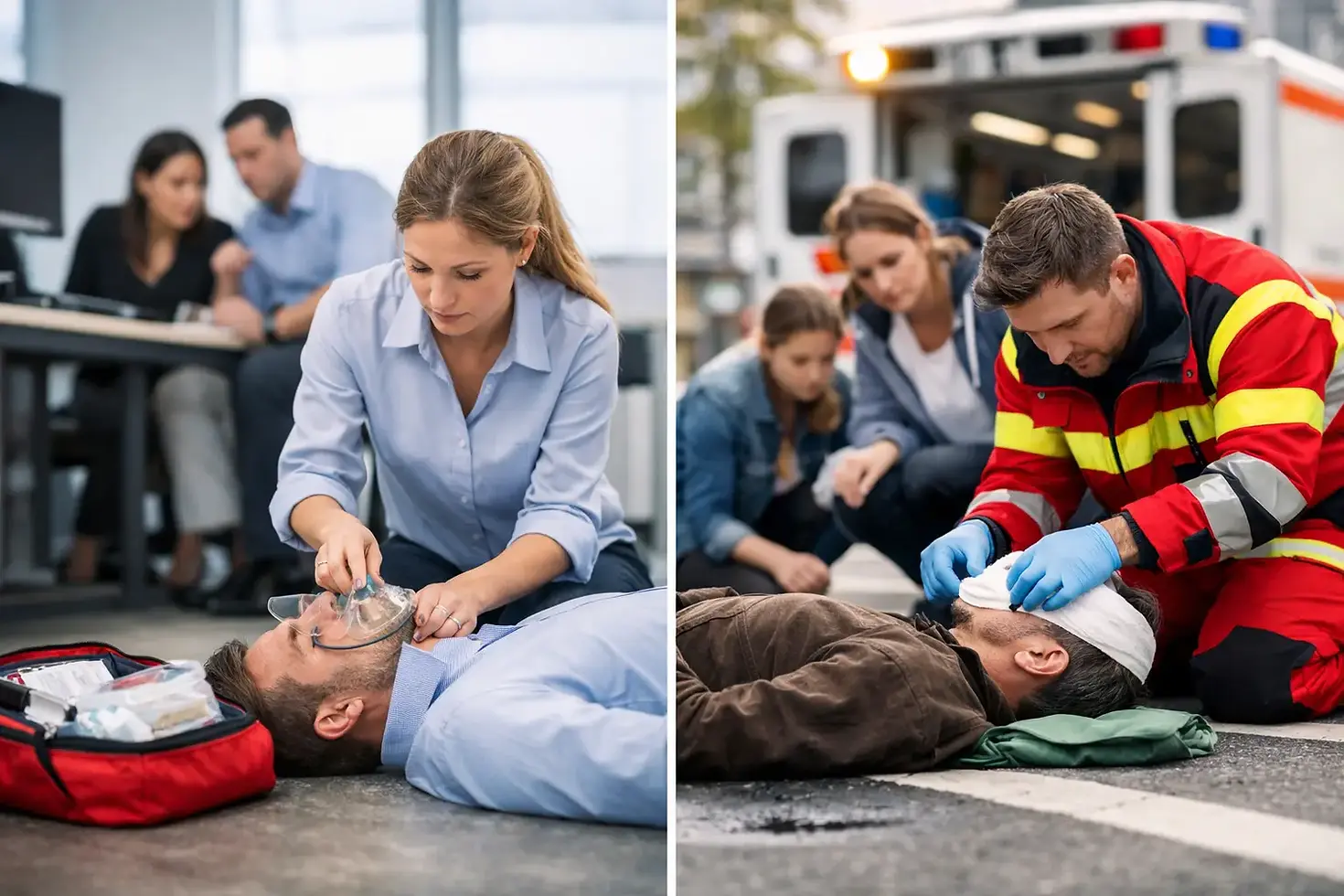
In-House vs Public First Aid: Which Fits?
A first aider may have to respond to a cardiac arrest in a busy office, a choking child in a nursery, a fall in a care setting or an injury on a warehouse floor. The decision between in-house vs public first aid training affects more than convenience. It affects whether your people can recognise the risks around them, use their skills under pressure and protect those in their care.
For many organisations, public courses are a sensible route to an individual qualification. But when several members of staff need training, or when your workplace has specific hazards, in-house delivery can provide a stronger fit. The right choice depends on your team, your risk assessment and the level of practical relevance you need.
What is the difference?
A public first aid course is attended by delegates from different organisations. It is usually delivered at a training venue on set dates, with individuals or small numbers of staff booked onto available places. This can work well when you need to train one person, have irregular recruitment needs or cannot release a larger team at the same time.
In-house first aid training is delivered for your organisation, normally at your workplace or another suitable site you arrange. Your staff train together, in the environment where they will be expected to act. The course still needs to meet the required standards, but the delivery can reflect the people, premises and likely emergencies your team faces.
Neither option is automatically right for every employer. The key is to look beyond the certificate and ask a more useful question: will this training help our people act quickly and competently when a real emergency happens here?
In-house vs public first aid: the practical differences
Relevance to your workplace
Public courses cover essential first aid skills, including assessing an emergency, CPR, use of an AED, recovery position, choking, bleeding, shock and common injuries. These are vital skills in any setting. However, the scenarios must remain broad because the room may include people from offices, shops, schools, construction firms and community groups.
In-house training allows the instructor to make those scenarios more familiar. A school can consider a pupil who has collapsed in the playground. A care provider can discuss the immediate priorities following a fall, while recognising individual care plans and escalation procedures. A warehouse team can practise managing an incident while keeping colleagues clear of vehicle routes or moving equipment.
That context matters. Under pressure, people often fall back on what they have practised. Training that reflects your environment helps staff connect the first aid process to the decisions they may need to make in the first few minutes.
Team confidence and communication
A public course can be an excellent learning environment, especially for a lone delegate who benefits from meeting others. Yet your trained first aiders will not be working alongside those strangers in an emergency. They will be working with their own colleagues.
When a team trains together, they can practise clear communication, delegate simple tasks and understand who is likely to be present at different times of day. They can discuss how to call emergency services from the site, where the first aid kits and AED are located, who meets the ambulance and how to manage other staff, pupils, visitors or service users.
This is not about creating false confidence. It is about replacing uncertainty with sensible, rehearsed action. A capable first aider still works within their training, calls for professional help early and follows workplace procedures. But they are less likely to lose valuable time wondering what happens next.
Time, travel and disruption
For a single employee, a public course may be the simplest option. There is no need to organise a room, coordinate a group or bring a trainer to site. It can be particularly useful for new starters, a replacement first aider or a small business with only one person requiring a qualification.
Once several people need training, the calculation changes. Sending staff individually to a public venue can mean separate travel, mileage or transport costs, staggered dates and repeated time away from work. It may also leave gaps in your cover while people attend at different times.
In-house delivery brings the course to your team. That often makes it easier to plan around rotas, school timetables, shift patterns and operational demands. A suitable training space is still needed, along with enough room for practical work on the floor, but the day can be arranged around your organisation rather than a fixed public timetable.
Cost and value
The cheapest course place is not always the best value. Public training is commonly cost-effective for one or two delegates. For larger groups, in-house training may offer better value per person because travel is reduced and the trainer is working with a full group from one organisation.
Value also includes the quality of the practice. First aid is practical. Staff need opportunities to perform CPR, use training equipment, respond to a choking casualty, control serious bleeding and make decisions in realistic scenarios. They should have time to ask questions about their own workplace, rather than trying to fit those questions into a mixed group with competing needs.
When comparing quotations, check what is included: the course level, certificate, practical assessment, trainer experience, equipment, group size and any travel charges. Most importantly, make sure the course is appropriate to the risks identified in your first aid needs assessment.
Start with your first aid needs assessment
Your first aid provision should not be based on headcount alone. Employers need to consider the nature of the work, workplace hazards, shift patterns, lone working, accident history, distance from emergency services, visitors and employees with particular needs. Schools, nurseries, care settings and community organisations must also consider the people they support, not only their staff.
A low-risk office with a small team may need a straightforward emergency first aid arrangement and occasional public-course places could be entirely suitable. A larger workplace, a site with higher-risk activities or an organisation responsible for children or vulnerable adults may need more trained people, a higher level of qualification and training tailored to the setting.
Your assessment should also consider absence. If all trained first aiders work the same shift, are based in one part of the building or take annual leave at the same time, your provision may not be adequate when it is needed. Training colleagues as a group can help build dependable cover across departments and shifts.
When public first aid training makes sense
Public training is often the right choice when you have one or two people to train, need a course date quickly or need to place a new staff member on a recognised qualification without waiting for a group booking. It can also suit self-employed people and community volunteers who do not have enough colleagues to form an in-house group.
It remains essential, however, to brief the delegate before they attend. They should know their expected role, where equipment is kept, who to contact internally and what incident reporting process applies. A qualification is only one part of being ready.
When in-house training is the stronger choice
In-house delivery is particularly valuable where several staff members require training, where the workplace has clear operational risks or where a team needs to work confidently together. It is a strong option for schools and nurseries, care homes, healthcare providers, warehouses, offices with multiple floors, community groups and employers with dispersed or shift-based staff.
It can also support training beyond standard workplace first aid. Paediatric first aid, Basic Life Support, anaphylaxis awareness, safe administration of medication, moving and handling, and evacuation chair training all benefit from practical discussion about your setting, equipment and procedures.
Training 2 U delivers instructor-led workplace training across Merseyside, Lancashire, Cheshire and Greater Manchester, led by professionals with more than three decades of frontline clinical experience. That experience brings real-world perspective to the skills staff may one day need to use when every second counts.
Do not treat the certificate as the finish line
First aid skills fade if they are not revisited. Qualified staff should know where supplies are held, check that equipment is accessible and understand any changes to workplace layout, staffing or procedures. Annual refresher training can keep essential actions fresh and give people the chance to practise again before a high-pressure situation tests them.
Choose public training when it genuinely suits the size and needs of your team. Choose in-house training when workplace relevance, shared practice and operational confidence will make the difference. The aim is the same in either case: protect your people, meet your responsibilities and ensure someone is ready to act when help cannot wait.


Comments