


10 Best First Aid Scenarios for Workplace Teams
A colleague collapses in the staff room. A pupil begins choking at lunchtime. A care resident has a suspected allergic reaction. These are the best first aid scenarios to practise because they demand calm, immediate action before professional help arrives. For employers, schools and care providers, preparation is not simply about holding a certificate. It is about protecting people when every second counts.
Practical first aid training gives staff a clear role in a frightening moment. They learn what to look for, when to call 999, how to give safe initial care and how to hand over useful information to ambulance crews. That confidence can save lives while helping your organisation meet its duty of care.
What makes a first aid scenario worth training for?
The right scenarios depend on your first aid needs assessment. A warehouse, nursery, office, school, care home and community venue face different risks, different people and different response times. Your assessment should consider the number of people on site, shift patterns, lone working, visitor numbers, known medical needs, workplace hazards and how quickly emergency services can reach the location.
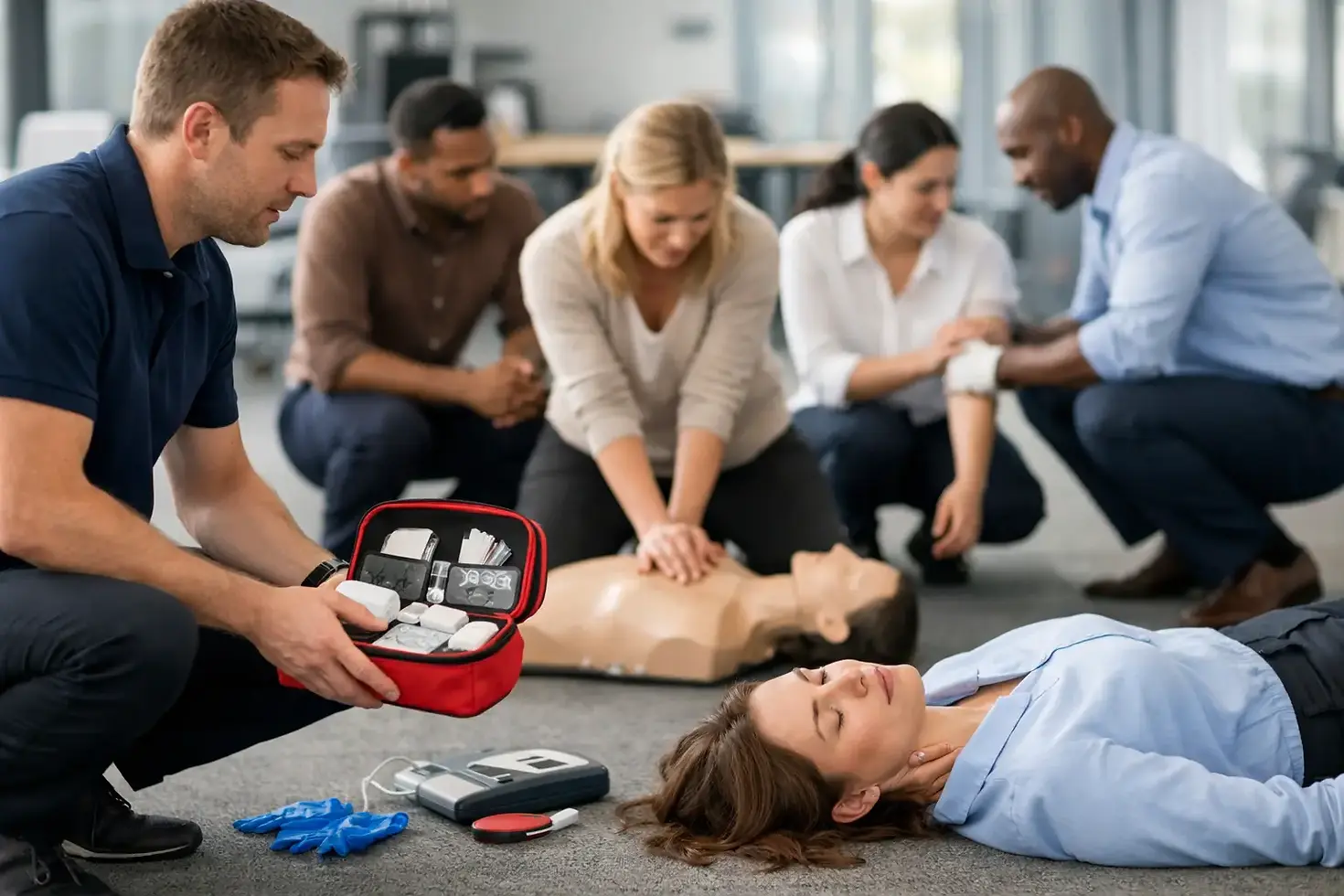
However, certain emergencies can happen almost anywhere. They are high consequence, time-critical and often made worse by hesitation. Training should give nominated first aiders plenty of opportunity to practise these situations, not merely discuss them in a classroom.
10 best first aid scenarios to practise
1. Cardiac arrest and CPR
A person who is unresponsive and not breathing normally needs an immediate emergency response. Staff must know how to check for danger, assess responsiveness, call 999, start CPR and send someone for an automated external defibrillator, if one is available.
This is one of the most important scenarios to rehearse because CPR is physically demanding and the situation can be distressing. Hands-on practice helps people act decisively, communicate clearly and continue until emergency professionals take over or the person shows signs of life.
2. Choking in adults and children
Choking can develop from a worrying cough into a life-threatening airway obstruction very quickly. Your team should be able to recognise the difference between someone who can cough effectively and someone who cannot breathe, speak or make a sound.
Training should cover the appropriate response for adults, children and infants, as the techniques are not identical. Schools, nurseries, care settings, cafés and staff kitchens should treat choking practice as essential, but every workplace benefits from it.
3. Severe bleeding
A deep cut from machinery, broken glass, a sharp tool or a workplace accident can cause serious blood loss. The first aider’s priorities are to keep themselves safe, call for help, apply firm direct pressure and manage the casualty for shock while monitoring their condition.
This scenario is especially relevant in manufacturing, construction, maintenance, hospitality and facilities teams. It is also valuable in offices and public-facing settings, where an incident involving glass or a fall can still result in significant injury. Staff need the confidence to act without becoming overwhelmed by the sight of blood.
4. Anaphylaxis
Anaphylaxis is a severe allergic reaction that can affect breathing and circulation. It may be triggered by food, medication, insect stings or other allergens. In a school, nursery, care environment or workplace with visitors, a first aider may be the person who notices the warning signs first.
Teams should understand the importance of calling 999 without delay, supporting the person in a suitable position and helping them use their prescribed adrenaline auto-injector where this is within their training and organisational procedures. A second injector may be needed, so staff should not assume the emergency has passed after the first dose.
5. Seizures
A seizure can look alarming, particularly to colleagues or pupils who have never seen one before. The safest response is often about preventing further harm: clear hazards away, cushion the person’s head, time the seizure and protect their dignity.
Staff must also know what not to do. Do not restrain the person or put anything in their mouth. Emergency help is needed in particular circumstances, including a seizure lasting longer than five minutes, repeated seizures, breathing difficulties, injury, pregnancy or a first seizure. A realistic scenario helps teams remember those decisions under pressure.
6. Burns and scalds
Hot drinks, ovens, catering equipment, chemicals and electrical equipment all create burn risks. The correct first response can limit damage and reduce pain. Staff should know to cool a thermal burn under cool running water for an appropriate period, remove jewellery or clothing near the area only where it is not stuck, and seek medical advice for serious or extensive burns.
Chemical and electrical burns require particular caution. The visible injury may not show the full extent of damage, and workplace procedures may include specific decontamination or isolation measures. This is why scenario-based training should reflect the hazards actually present on your site.
7. Falls, suspected fractures and head injuries
Slips, trips and falls are common across workplaces, schools and care settings. A person may have a suspected fracture, spinal injury or head injury even if they initially say they are fine. Moving them unnecessarily can make an injury worse.
Practise how to secure the area, reassure the casualty, assess for immediate danger and summon appropriate help. Teams should also understand when a head injury needs urgent medical assessment, particularly if there is loss of consciousness, confusion, vomiting, worsening headache or changes in behaviour.
8. Asthma attacks and breathing difficulties
Breathlessness can be caused by asthma, an allergic reaction, chest pain, panic, infection or another medical emergency. First aiders do not need to diagnose the cause, but they do need to recognise when breathing is difficult and escalating.
A scenario should teach staff to encourage the person to use their own prescribed inhaler, help them sit in a comfortable position and call 999 if symptoms are severe, do not improve or the person becomes exhausted, confused or unresponsive. Clear escalation is more useful than guesswork.
9. Diabetes emergencies
A person with diabetes may become shaky, sweaty, confused, irritable or unusually drowsy if their blood glucose is low. They may need fast-acting sugar if they are awake and able to swallow safely. If they are unconscious, having a seizure or unable to swallow, they need emergency help and nothing should be put in their mouth.
This scenario matters where staff support pupils, residents, customers or colleagues with known diabetes. It also reminds teams to take changes in behaviour seriously rather than assuming someone is simply tired, unwell or difficult.
10. Shock after illness or injury
Shock can follow serious bleeding, burns, allergic reactions, infection, trauma or a major medical event. The casualty may look pale, feel cold, become weak or restless, breathe quickly and deteriorate rapidly.
First aiders should learn to recognise these changes, seek emergency support early, keep the person comfortable and monitor their breathing and responsiveness. The key lesson is that a casualty’s condition can change. Good first aid is not a single action followed by a wait. It is ongoing observation and reassessment.
Make scenarios relevant to your workplace
Generic training is useful, but realistic workplace practice is more memorable. A school team may need to manage a playground head injury, a choking child or an asthma emergency. A care provider may need scenarios involving falls, seizures, medication and deteriorating residents. An employer with workshop staff may need to focus on bleeding, burns, crush injuries and emergency evacuation.
Use the actual spaces your staff work in where possible. Consider how they would call for assistance, who would meet the ambulance, where the first aid kit and defibrillator are kept, and whether there are barriers such as locked gates, large sites or lone workers. These details can determine how quickly help reaches the casualty.
Training also needs refreshing. Skills fade when they are not used, and procedures, staff teams and workplace risks change. Annual refresher training gives people a chance to practise CPR, review emergency equipment and correct uncertainty before a real incident exposes it.
Give your people a response they can rely on
The strongest first aid provision combines the right number of trained people, suitable equipment, clear emergency arrangements and practical practice. It should never be treated as a tick-box exercise. Your staff need to know that they have permission to act, support from colleagues and a straightforward plan when someone becomes unwell or injured.
Training 2 U delivers instructor-led, practical first aid training at workplaces across Merseyside, Lancashire, Cheshire and Greater Manchester, led by professionals with more than three decades of frontline clinical experience. Choose training that reflects your risks, protects the people in your care and leaves your team ready to respond when it matters most.


Comments